TradeHub Tools Field Reference Chart
NEC 314.16 Box Fill Volume Chart
Source scope: NEC 314.16-based box fill volume allowance inputs for common branch-circuit conductors. Field reference only; not an official NEC table replacement.
Page URL: https://www.tradehub.tools/resources/electrical/field-tables/box-fill-volume-chart
Primary Field Chart
Box Fill Volume Allowance Chart
Use this chart to check common box fill volume allowance values for standard branch-circuit conductor sizes. The chart is an input reference, not a complete box-fill approval.
| Conductor Size | Volume Allowance | Common Field Use | Calculator Boundary |
|---|---|---|---|
| 14 AWG | 2.00 in³ | Common 15A branch-circuit conductor allowance. | Use calculator when devices, clamps, grounds, or mixed sizes are present. |
| 12 AWG | 2.25 in³ | Common 20A branch-circuit conductor allowance. | Use calculator when yokes, internal clamps, or EGC allowances apply. |
| 10 AWG | 2.50 in³ | Common 30A branch-circuit or larger appliance conductor allowance. | Use calculator when multiple conductor groups share one box. |
| 8 AWG | 3.00 in³ | Larger branch-circuit or feeder conductor allowance. | Verify box marking and fill conditions before relying on the chart alone. |
| 6 AWG | 5.00 in³ | Large conductor allowance; box volume is often the limiting condition. | Run the full box fill calculation before layout decisions. |
Chart note: this is a focused TradeHub field reference for common conductor volume allowance inputs. It does not reproduce the full NEC table set and does not decide the complete box fill result by itself.
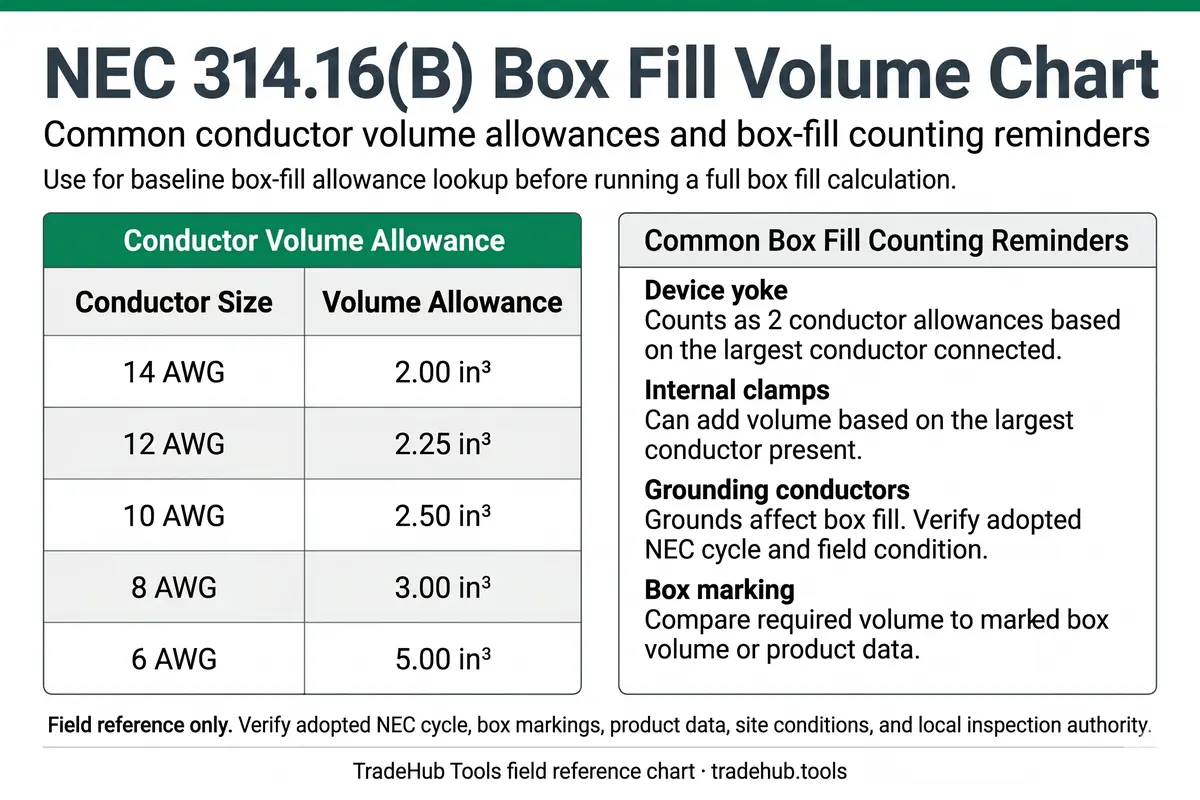
Calculator-use note: Use the Box Fill Calculator when devices, clamps, fittings, grounding conductors, mixed conductor sizes, or box markings affect the final box volume result.
TradeHub Tools field reference only. Verify against the adopted NEC cycle, equipment markings, site conditions, and local inspection authority.
Counting Rules
Box Fill Counting Rules
Box fill is not only a conductor-size lookup. Devices, internal clamps, grounding conductors, support fittings, and mixed sizes can change the required volume quickly.
| Field Item | Field Count Basis | Why It Matters |
|---|---|---|
| Insulated conductors | Count by conductor size when the conductor is part of the box fill calculation. | Each included conductor uses the volume allowance tied to that conductor size. |
| Device yokes | Common field check: two conductor allowances based on the largest conductor connected to the yoke. | A duplex receptacle or switch can add more required volume than a user expects. |
| Internal clamps | Internal clamps can require an allowance based on the largest conductor present. | Built-in clamps can change the box fill result even when the conductor count looks acceptable. |
| Grounding conductors | Review adopted code cycle and grounding-conductor conditions. | Grounding conductors occupy box volume and should not be ignored in the layout. |
| Box marking | Compare required volume against the marked box volume or reliable product data. | The chart gives allowance inputs; the installed box still needs enough rated volume. |
Scope Boundary
When This Chart Applies
- Use it for allowance lookup: The chart helps identify common cubic-inch volume allowances for 14 AWG through 6 AWG conductors.
- Use it before the full calculation: It supports rough field checks before adding devices, clamps, fittings, grounding conductors, and box volume markings.
- Do not treat it as approval: The chart does not decide whether the installed box passes box fill, device spacing, support, equipment listing, or local inspection requirements.
Calculator Handoff
When to Use the Box Fill Calculator
Use the chart for quick volume allowance lookup. Switch to the calculator when the layout includes multiple conductor sizes, devices, yokes, internal clamps, equipment grounding conductors, support fittings, or a known box volume that must be checked against the required fill.
Box getting more complex than a simple allowance lookup?
The Box Fill Calculator applies the layout inputs together so a field user does not have to add device, clamp, grounding, conductor-size, and volume allowances manually.
Related Code References
Source Scope
Source Alignment and Use Scope
This TradeHub field reference is based on NEC 314.16 box fill volume allowance concepts and related TradeHub source alignment records. It is for screening and planning only. It does not reproduce the full NEC table set, replace adopted code text, override box markings, product data, equipment listings, manufacturer instructions, site conditions, or the local inspection authority. Review the TradeHub Code Citation & Source Log and TradeHub Methodology for source-review boundaries.
FAQ
Box Fill Volume FAQ
Can this chart replace a full box fill calculation?
No. The chart gives common volume allowance inputs. Use the Box Fill Calculator when devices, clamps, grounding conductors, support fittings, mixed conductor sizes, or box markings affect the result.
How is a device yoke counted?
A common field check counts a device yoke as two conductor volume allowances based on the largest conductor connected to the yoke. Verify the adopted NEC cycle and actual device conditions before relying on the result.
Do grounding conductors count for box fill?
Yes. Grounding conductors affect box fill. Review the adopted NEC cycle and field condition, or use the Box Fill Calculator when grounding conductor counts or sizes are part of the layout.