TradeHub Tools Field Reference Chart
Standard OCPD Sizes Chart
Source scope: NEC 240.6(A) standard OCPD ampere rating reference with next-size-up boundary notes. Field reference only; not an official NEC table replacement.
Page URL: https://www.tradehub.tools/resources/electrical/field-tables/standard-ocpd-sizes-chart
Primary Field Chart
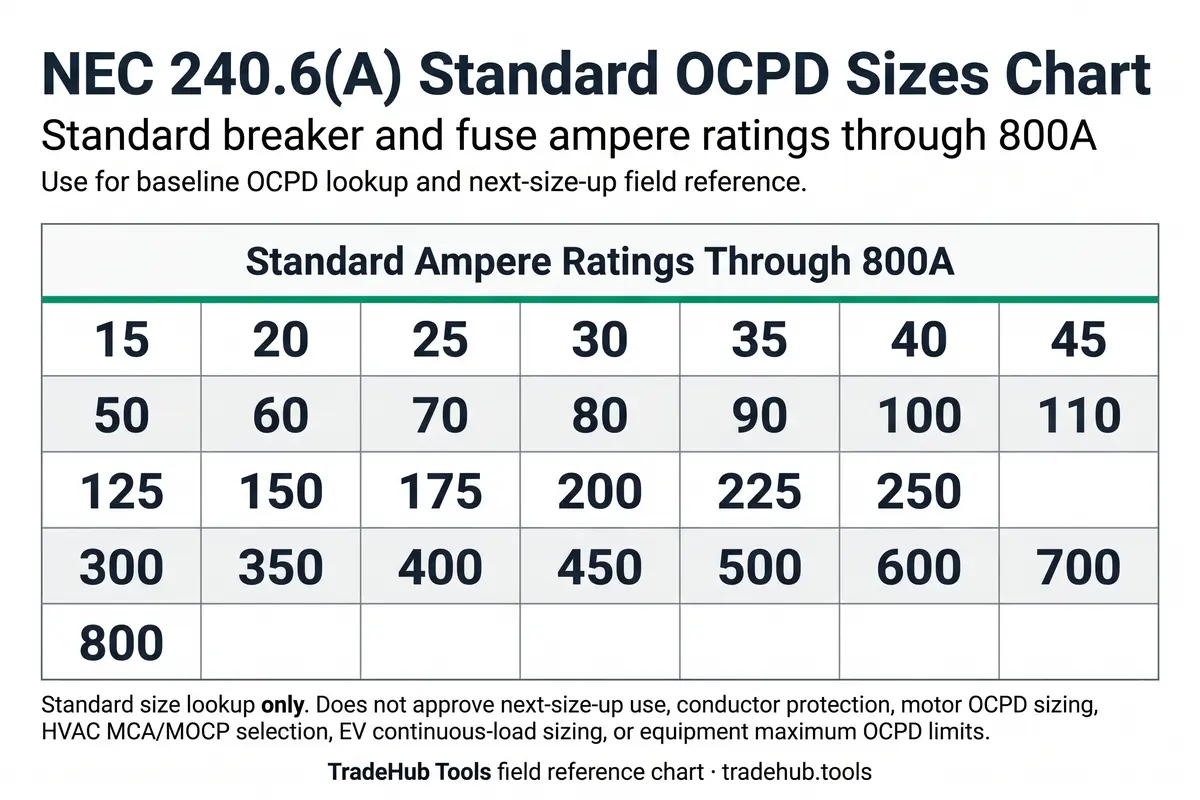
Standard OCPD Size Chart
This TradeHub field chart groups standard OCPD ampere ratings through 800A for quick lookup. The chart does not decide whether an OCPD may be rounded up, whether a conductor is protected, or whether equipment instructions allow the selected rating.
| Rating Range | Standard OCPD Sizes | Field Note |
|---|---|---|
| 15–60A | 15, 20, 25, 30, 35, 40, 45, 50, 60 | Common smaller branch-circuit and feeder OCPD sizes. Check small conductor limits and load type before applying any next-size-up logic. |
| 70–125A | 70, 80, 90, 100, 110, 125 | Common feeder and equipment range. Verify conductor ampacity, terminal temperature, equipment rating, and continuous-load conditions. |
| 150–250A | 150, 175, 200, 225, 250 | Common service, feeder, and equipment range. The standard size alone does not approve the installation. |
| 300–800A | 300, 350, 400, 450, 500, 600, 700, 800 | Large feeder and service range. Confirm equipment listings, conductor sets, available fault current, local amendments and AHJ requirements. |
This chart is a standard-size lookup only for NEC 240.6(A) ratings through 800A. It does not approve next-size-up use, small conductor protection, motor OCPD sizing, HVAC MCA/MOCP selection, EV continuous-load sizing, or equipment maximum OCPD limits.
Use the Breaker Size Calculator when continuous loads, EV chargers, HVAC MCA/MOCP, motors, small conductor rules, or equipment instructions change the simple standard-size lookup.
TradeHub Tools field reference only. Verify against the adopted NEC cycle, conductor ampacity, terminal temperature, equipment instructions, site conditions, and local inspection authority.
Scope Boundary
When This Chart Applies
- Use it as a standard-size lookup: This chart helps identify standard OCPD ampere ratings through 800A for field planning and calculator review.
- Do not use it as approval to round up: The next-size-up rule depends on load, conductor ampacity, equipment limits, and specific NEC conditions.
- Check special cases separately: Small conductors, motors, HVAC equipment, EV charging, continuous loads, and listed equipment maximum OCPD values can change the result.
Calculator Handoff
When to Use the Breaker Size Calculator
Use the standard-size chart for quick rating lookup. Use the calculator when the selected OCPD depends on calculated load, continuous-load treatment, conductor ampacity, EV charging, HVAC MCA/MOCP, motor rules, or equipment instructions.
Related Code References
Source Alignment
Source Alignment and Use Scope
This TradeHub field reference chart is based on NEC 240.6(A) standard OCPD ampere rating structure and related TradeHub source alignment records. It is for screening and planning only. It does not reproduce the full NEC table set, approve next-size-up use, override conductor ampacity, replace equipment instructions, or substitute for the adopted code, site conditions, or local inspection authority. Review the TradeHub Code Citation & Source Log for source alignment records and the TradeHub Methodology page for how field references are scoped.
Common Questions
Standard OCPD Size FAQ
What are standard OCPD sizes used for?
Standard OCPD sizes are used to match calculated loads and conductor protection requirements to recognized ampere ratings. They do not by themselves approve a breaker or fuse for a specific installation.
Can I always round up to the next standard OCPD size?
No. The next-size-up rule has conditions and exceptions. Small conductor limits, equipment maximum OCPD ratings, motor rules, HVAC MCA/MOCP, EV continuous loads, and conductor ampacity can change the answer.
Is OCPD sizing the same as wire sizing?
No. OCPD sizing and conductor sizing are linked, but they are separate checks. Conductor ampacity, terminal temperature, derating, voltage drop, equipment instructions, and load type must also be reviewed.